
The "How-To" Guide to Executing SEO
Most business owners and marketers understand the vocabulary of SEO. You know what a keyword is; you understand that being on Page 1 is good. But the gap between knowing definitions and achieving resu

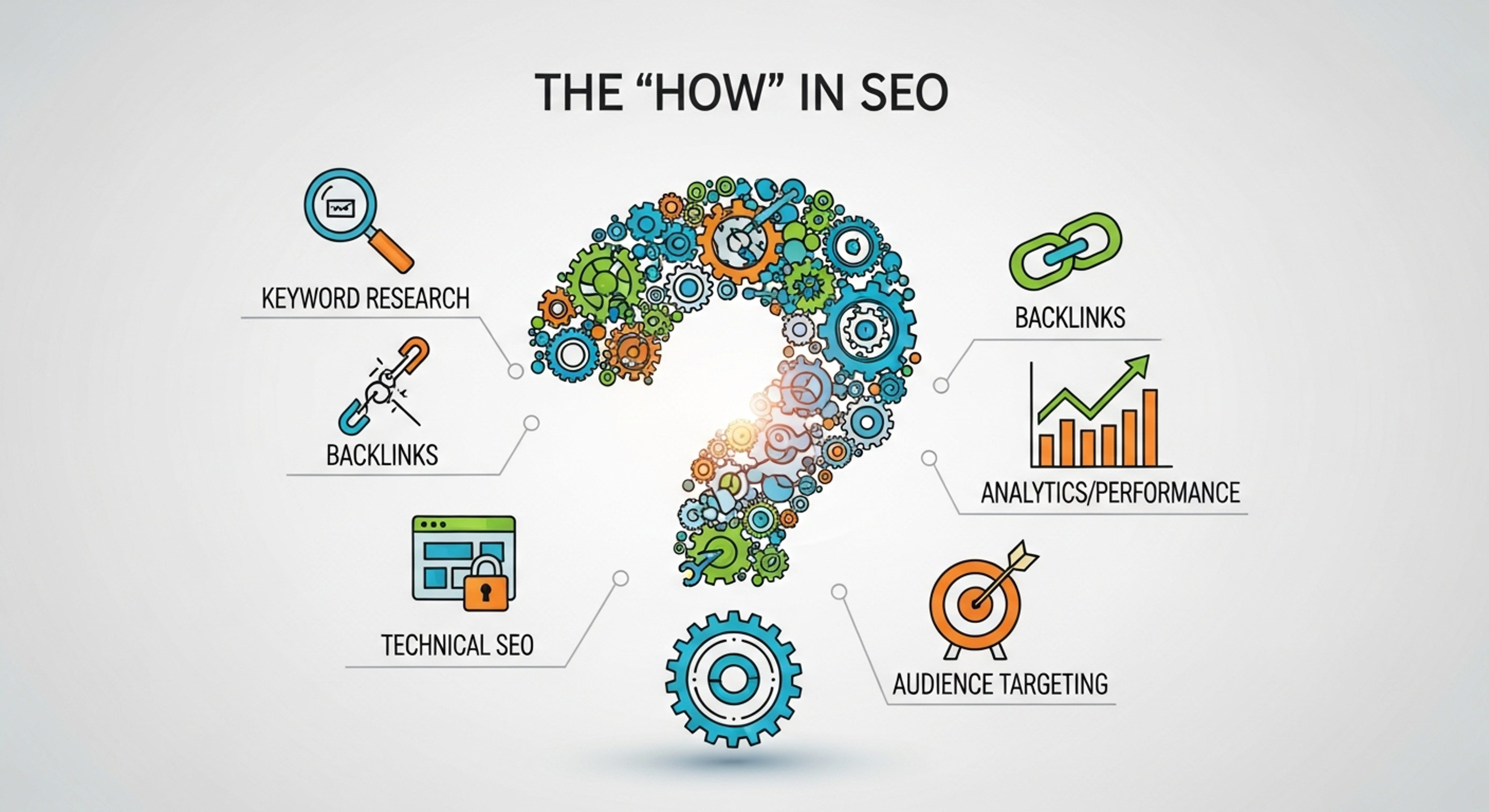
The Problem: Theory doesn’t rank websites; execution does. Too many guides stop at “write quality content” without explaining the mechanical structure required for crawlers to read that content.
The Promise: This article skips the fluff. We are treating SEO not as a dark art, but as a verifiable workflow. Below is your roadmap to transitioning from “doing SEO” in theory to executing it in practice.
Phase 1: Technical Execution (The Foundation)
Theme: How to ensure Google can read and understand your site.
Before you write a single word, you must ensure the technical infrastructure of your site invites Google in rather than locking it out.
A. How to Configure Indexability
If Google cannot crawl your site, you do not exist.
Robots.txt Setup: This is the gatekeeper file that tells search engine bots where they are allowed to go. The Execution: Create a robots.txt file in your root directory. The Code: Use the following syntax to allow access to content while protecting sensitive admin areas:
Plaintext
User-agent: *
Disallow: /wp-admin/
Allow: /
XML Sitemap Submission: Think of this as giving Google a map of your site so it doesn’t have to wander blindly. The Execution: If you use WordPress, use a plugin like RankMath or Yoast to auto-generate this. If you are on a custom build, use an XML generator script. The Action: Go to Google Search Console (GSC) > Sitemaps and paste your URL (usually domain.com/sitemap_index.xml).
Canonicalization: This prevents “duplicate content” issues (which dilute your ranking power) by telling Google which URL is the “master” copy. The Execution: Ensure every page has a self-referencing canonical tag in the <head> section:
HTML
<link rel=”canonical” href=”https://yourwebsite.com/current-page-slug/“ />
B. How to Optimize Performance (Core Web Vitals)
Google explicitly uses “Page Experience” as a ranking factor. A slow site is a de-ranked site.
Speed Optimization (LCP): You need your Largest Contentful Paint (LCP) to load in under 2.5 seconds. The Execution: Stop uploading raw images. Convert all images to WebP format (using tools like Squoosh.app) and ensure your server uses GZIP or Brotli compression for CSS/JS files.
Mobile Usability: Google uses “Mobile-First Indexing.” They look at your mobile site, not your desktop site, to determine rankings. The Execution: Open Chrome Developer Tools (F12), toggle “Device Mode,” and test your touch targets. Buttons must be large enough for a thumb, and text must not run off the screen.
Phase 2: Strategic Planning (The Map)
Theme: How to choose battles you can actually win.
Blindly creating content is a waste of budget. You must align with data.
A. How to Conduct Execution-First Keyword Research
Intent Matching: The biggest mistake in SEO is trying to rank a product page for an informational search. The Execution: Google your target keyword before you write. If the top 3 results are Calculators $\rightarrow$ Build a tool. If the top 3 results are Listicles $\rightarrow$ Write a “Top 10” list. Rule: Do not fight the SERP (Search Engine Results Page) intent; mirror it.
The “Keyword Gap” Analysis: The fastest way to grow is to see where your competitors are winning and you are absent. The Execution: Use a tool like Ahrefs or Semrush. Enter a competitor’s domain. Select “Content Gap.” Filter for keywords with a Difficulty (KD) of < 30. These are your immediate targets.
B. How to Structure Site Architecture
Topic Clusters (The Silo Method): Google prefers websites that look like organized libraries, not messy attics. The Execution: Create a Pillar Page covering a broad topic (e.g., “Digital Marketing”). Write 5–10 Cluster Pages on specific sub-topics (e.g., “Email Marketing,” “PPC Guide,” “SEO Basics”). Crucial Step: Link every Cluster Page back to the Pillar Page, and link the Pillar Page out to the Clusters. This creates a tight web of relevance.
Phase 3: On-Page Implementation (The Content)
Theme: How to speak Google’s language while writing for humans.
A. The HTML Hierarchy
Structure provides context. You must tag your content so algorithms can prioritize information.
Title Tags & Meta Descriptions: The Execution: Place your primary keyword as close to the start of the Title Tag as possible. For the Meta Description, keep it under 155 characters and treat it like an ad copy—include a clear Call-to-Action (CTA).
Header Tag Logic: H1: Only one per page. This is the title. H2: These are your main chapters. Include secondary keywords here. H3: These are sub-points within the chapters.
B. Content Optimization Tactics
Semantic SEO (LSI Keywords): Google no longer counts how many times you typed “Coffee.” It looks for context. The Execution: If writing about “Coffee,” you must include semantically related terms like “beans,” “roast,” “grinder,” “acidity,” and “brewing temperature.” Use tools like SurferSEO or Clearscope to identify these missing semantic gaps.
Internal Linking Strategy: This is how you pass “link juice” (authority) around your site. The Execution: Every time you publish a new article, find 3 older, relevant articles on your site. Edit them to add a link pointing to your new article. Note: Use descriptive anchor text (e.g., “learn more about SEO strategy”) rather than generic text (e.g., “click here”).
C. Image SEO
Alt Text & Filenames: The Execution: Never upload IMG_5922.jpg. Rename the file to seo-strategy-diagram.jpg. Once uploaded, fill out the “Alt Text” field describing the image for accessibility and crawlers.
Phase 4: Off-Page Authority (The Reputation)
Theme: How to earn votes of confidence from the web.
You can have the best content in the world, but without backlinks (citations from other sites), Google may not trust you.
A. Link Building Implementation
The “Skyscraper” Technique: The Execution: Find a top-ranking article for your keyword that is outdated (e.g., “SEO Trends for 2019”). Write a significantly better, updated version. Then, use an SEO tool to find everyone who linked to the old article and email them:
“Hi [Name], I saw you linked to this guide on SEO. It’s great, but a bit outdated. I just published a version updated for 2025. It might be a better resource for your readers.”
Digital PR & Connectively: The Execution: Sign up for Connectively (formerly HARO). Journalists constantly request expert quotes. Reply to them. If they use your quote, you earn a high-authority backlink from a news site.
B. Local SEO
Google Business Profile (GBP): The Execution: If you have a physical presence, claim your GBP. Verify your address. Post weekly updates (photos/offers) and respond to 100% of reviews. This activity signals to Google that the business is alive and relevant.
Phase 5: Monitoring & Iteration (The Pulse)
Theme: How to know if it’s working.
A. Setting Up the Feedback Loop
Google Search Console (GSC): The Execution: Check the “Performance” tab weekly. Look for “Striking Distance” keywords. These are queries where you rank in positions 11–20. The Fix: Add a paragraph to that page specifically addressing that keyword to bump it to Page 1.
Updating Content (Content Freshness): The Execution: Every 6 months, audit your top 10 traffic-driving pages. Update the statistics, check for broken links, and add a “Current Year” section. This resets the “Freshness” score in the algorithm.
Discussion: The Ecosystem of Execution
The transition from SEO theory to SEO success is rarely a knowledge problem; it is an integration problem. As detailed in this guide, a website does not rank based on a single variable, but rather on the harmonious execution of five distinct phases.
We can view these phases as a hierarchy of needs for your digital presence:
Technical Integrity (The Access): Without the foundational work of robots.txt, XML sitemaps, and canonicalization, you are essentially building a library with the doors locked. Furthermore, Core Web Vitals have shifted technical SEO from a backend concern to a user experience imperative; if your site is slow or breaks on mobile, Google will abandon it regardless of content quality.
Strategic Alignment (The Direction): Execution without strategy is noise. By pivoting to intent matching and creating topic clusters (silos), you stop fighting the algorithm and start organizing your content the way Google organizes its own database. The Keyword Gap analysis ensures you are not just writing, but actively competing for market share.
On-Page Precision (The Language): While humans read stories, bots read HTML. The disciplined use of Header tags (H1-H3), Title Tags, and Alt Text translates your human value into machine-readable signals. Semantic SEO takes this further by providing the contextual depth needed to prove topical authority.
Off-Page Authority (The Trust): You cannot rank in a vacuum. Link building through the “Skyscraper Technique” and Digital PR provides the external validation, the “votes” that separate established brands from hobby blogs.
Iterative Monitoring (The Growth): Finally, the feedback loop provided by Google Search Console turns SEO from a guessing game into a data science. Regular audits for content freshness ensure that your hard work doesn’t decay over time.
When these five gears turn in unison, SEO stops being a “dark art” and becomes a predictable revenue channel.
Conclusion: From Knowledge to Action
The era of “tricking” search engines is over. Today, executing SEO means building a technically sound, user-centric, and authoritative resource.
To recap, here are the non-negotiable pillars of execution:
Fix the Foundation: Ensure your site is indexable via a clean robots.txt and sitemap, and optimized for speed (WebP images, caching) to satisfy Core Web Vitals.
Map the Territory: Do not write blindly. Use Keyword Gap Analysis to find opportunities and structure them into Topic Clusters that link back to a central Pillar Page.
Structure the Content: Write for humans, but format for bots. Use Schema, Meta descriptions, and Semantic keywords to make your relevance undeniable.
Earn the Reputation: actively seek backlinks through Digital PR and outreach. If you are a local business, your Google Business Profile activity is as critical as your website.
Maintain the Pulse: Use GSC to identify “striking distance” keywords and update old content every six months to maintain freshness.
The gap between Page 10 and Page 1 is action. Theory is safe, but execution is profitable.